
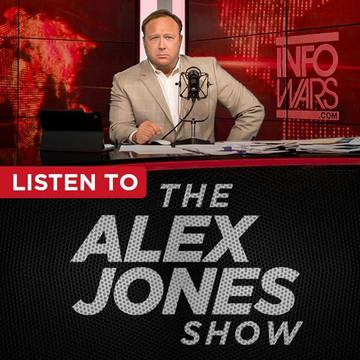
Whole-show assessment
The Alex Jones Show
Alex Jones
EVERY FEAR BECOMES A CONSPIRACY, AND EVERY CONSPIRACY LEADS BACK TO THE STORE
This is not skepticism taken too far. It is a system that makes itself impossible to disprove, turns real people into targets and sells products inside the panic it creates.
This is editorial opinion about recurring patterns across the show, not a claim that every episode shares every fault. We assess the guests, framing, questions, challenges, context, corrections and distribution choices visible in the published work—without claiming a secret agreement or motive. Examples are factual anchors, and reported allegations are labeled as such.
Why it is popular
- Jones performs certainty and urgency with enormous energy. The show feels like an emergency broadcast from someone who knows the hidden plan.
- He mixes real government failures with invented connections, making the invention feel researched.
- The worldview removes randomness. Nothing merely happens; everything has a planner and a purpose.
- Listeners become insiders who believe they can see what the passive public cannot.
Why it sucks
- Failed predictions vanish while partial matches are replayed as proof that Jones predicted everything.
- Jones chooses the alarming guest, supplies the approving frame and moves on before unsupported claims can be properly tested.
- People harmed by tragedy become props inside a story built for Jones's audience.
- The program repeatedly moves from fear to product sales, making the news, interview and store parts of one emotional system.
How it makes you dumber
- Suspicion becomes evidence. The stranger a claim sounds, the more important it can feel.
- Coincidence becomes planning, uncertainty becomes concealment and correction becomes censorship.
- You remember the rare prediction that vaguely resembled an event and forget the large number that failed.
- Every institution capable of checking the claim is declared corrupt, leaving no stable route back to shared facts.
The reasoning tricks it uses
- The claim cannot lose: evidence supports the conspiracy and missing evidence proves the cover-up.
- When one version fails, a looser version replaces it.
- Events close together in time are treated as cause and effect.
- Dozens of documents, names and guesses arrive too quickly for any link to be checked.
- The false choice is Jones's theory or total trust in every government and corporation.
How it spreads bad information
- Jones repeatedly called the Sandy Hook massacre staged or a hoax. Courts held him liable, and a Connecticut appellate court upheld $965 million in compensatory damages.
- The appellate record describes threats and harassment endured by families as the lies spread.
- The FDA and FTC warned Free Speech Systems over unsupported claims used to market silver products during COVID-19.
- The show has no dependable correction system. Retractions arrive late, conditionally or inside a new claim that protects the larger conspiracy.
Who it helps look credible
- Fringe sellers and conspiracy promoters are introduced as researchers persecuted for telling the truth.
- Rejection by courts, universities, regulators or other platforms becomes part of the sales pitch.
- Affirming questions, claims left standing and missing records can make an unreliable guest feel like a brave insider without Jones having to prove the case.
- Larger hosts who present Jones as an entertaining friend or prophet help erase the documented damage behind his record.
- Wildness itself becomes credibility: saying what ordinary media will not is made to look like knowing what ordinary media does not.
How it benefits at your expense
- Court testimony reported that roughly 80% of Free Speech Systems revenue probably came from store sales.
- The show creates fear about health, collapse and government control, then sells supplements and survival products into that fear.
- The audience pays for products whose urgency depends on continuing to believe the emergency.
- Sandy Hook families paid an immeasurably greater cost through harassment and renewed trauma while the false story drew attention.
What it keeps teaching underneath
- No tragedy is allowed to remain a tragedy; victims can always be recast as actors in the plot.
- Democratic systems are presented as fake, making ordinary civic action feel useless.
- Violence and authoritarian rescue can feel reasonable if an all-powerful hidden enemy supposedly controls everything.
- The listener is encouraged to fear everyone while trusting the one person continually frightening them.
Why well-read critical thinkers steer clear
- A theory that treats both evidence and missing evidence as proof cannot produce a useful investigation or an honest stopping point.
- Checking the flood of names, documents and predictions costs far more time than making the claims.
- Court records, original documents and careful reporting provide verifiable facts without the panic and sales pressure.
- The repeated result is more suspicion rather than a conclusion that can be tested, so even a skeptical listener gets little reliable knowledge in return for the attention.
Sources and factual anchors
- Associated Press on the upheld Sandy Hook verdict
- FDA warning letter to Free Speech Systems
- Courthouse News on the default judgment and discovery failures
- Washington Post investigation of the business and litigation
Sources anchor specific factual examples. The overall assessment and conclusions are editorial opinion.